
Mokker AI
Pick Mokker if your products carry detail that has to survive, or if you want to test without buying credits first. Check the model range against your actual customers before committing, because that is the complaint its reviewers raise.
These two do the same thing closely enough that comparing scene quality is a waste of a page. What separates them in practice is whether the product you uploaded is still the product in the picture.
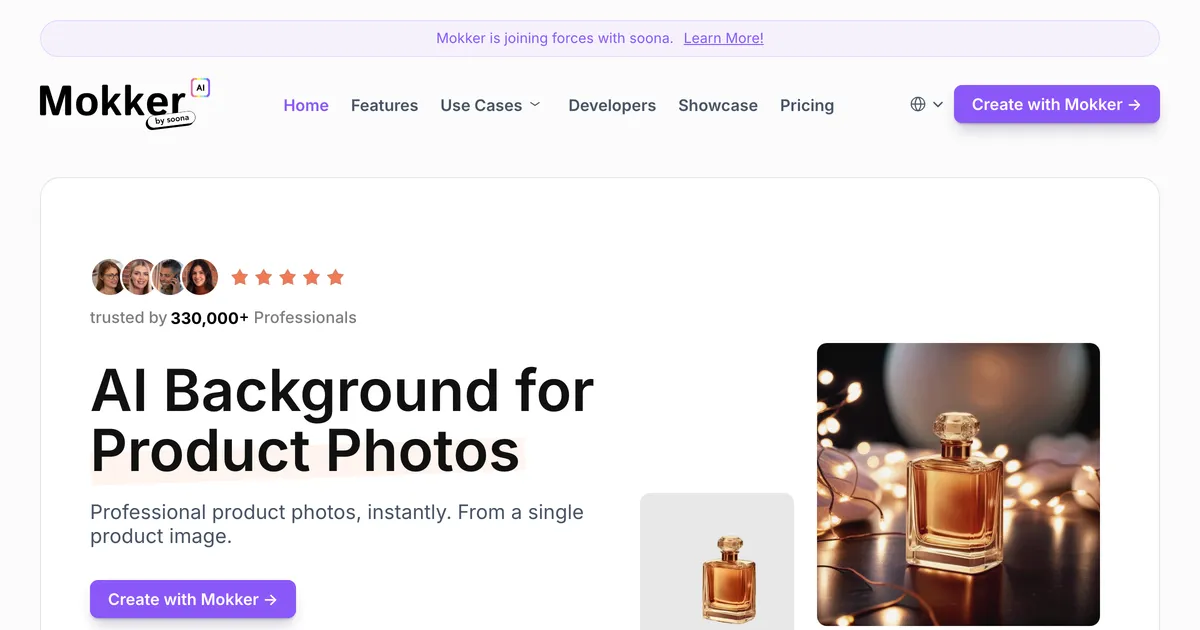
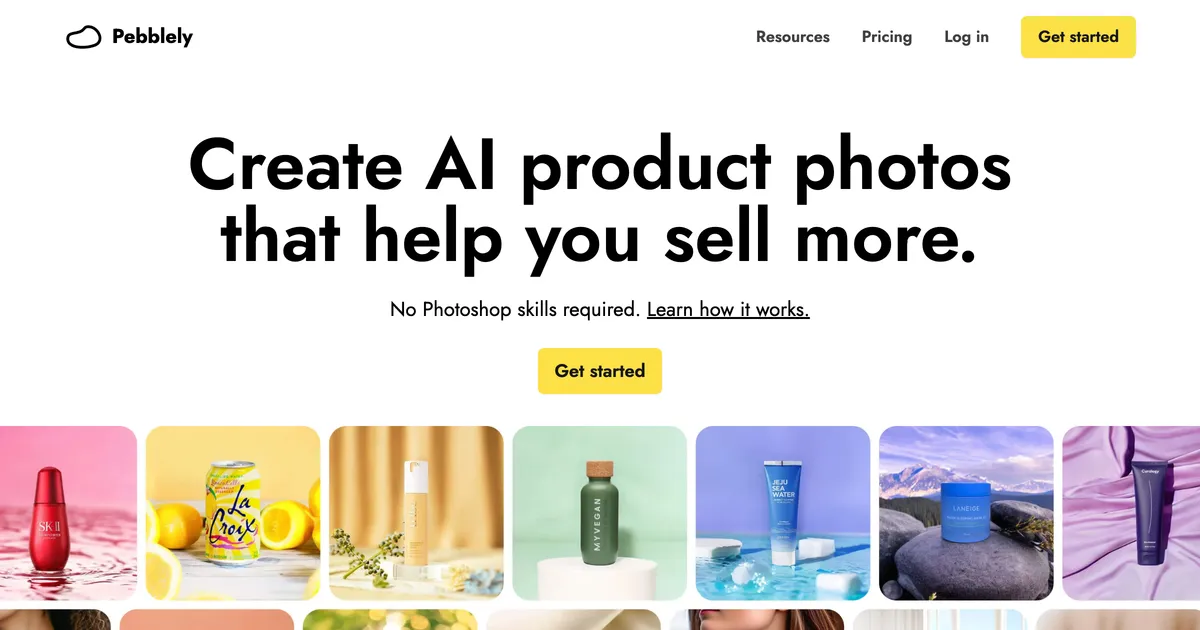
Pick Mokker if your products carry detail that has to survive, or if you want to test without buying credits first. Check the model range against your actual customers before committing, because that is the complaint its reviewers raise.
Pick Pebblely if your products are simple enough that generation leaves them alone, and you want the wider range of scenes. Buy the smallest credit bundle first: reviewers report it altering products and each correction is charged.
Both start from a photograph of a real item. If your product does not exist until someone orders it, neither has anything to work with.
Both take a photograph and build an environment around it, and on a simple object with clean edges both produce something better than most sellers would stage themselves. That is the easy case and it is where the marketing screenshots live.
The hard case is a product with detail that must survive: text on packaging, a logo, a distinctive silhouette, fine texture. Generation is under no obligation to preserve any of that, and a Pebblely reviewer describes precisely this outcome, saying it ignores instructions and alters the product as it pleases, with each correction costing credits.
Mokker attracts a different complaint. Its reviewers write about the range of models being narrow rather than about the product being wrong, which is a problem of fit rather than of fidelity. Neither is a clean bill of health, and the practical consequence is the same for both: test on your most detailed product rather than your simplest, because that is where the difference between them shows up and where the cost of being wrong lands.
| What you are comparing | Winner | Why |
|---|---|---|
| Preserving the product | Mokker AI | Not because it is proven better, but because Pebblely has documented reviewer complaints about altering the item and Mokker's complaints are elsewhere. |
| Cost of a failed attempt | Mokker AI | Pebblely charges credits per generation, so a product it keeps getting wrong is one that keeps costing money to retry. |
| Range of models and scenes | Pebblely | Mokker's most specific complaint is the narrow age range of its models, which matters if your buyers are older. |
| Testing before paying | Mokker AI | Pebblely has no ongoing free tier, only a trial, so evaluating it on your awkward products costs money up front. |
| Consistency across a set | Tie | Both generate, so both vary between runs. Neither has solved the matching-set problem and neither claims to. |
| Use for print on demand | Tie | Neither applies. Both need a photograph of a real item, and print on demand products usually do not exist until ordered. |
Annual billing advertised as up to 35% off. The free tier is a one-time 20 photos rather than a monthly allowance.
No free tier listed on the pricing page, contrary to several aggregator posts. Yearly billing advertised as 2+ months free.
Our own pricing.
This is where generation edits what it should preserve, and it is where Pebblely's reviewers report problems specifically.
The easy case, where both work and the wider scene range is the deciding factor.
A Mokker reviewer flags a model range skewed almost entirely young, which makes the scenes wrong for that audience.
Both need a photograph. Print on demand images have to be built from the design instead.
AI product photography aimed at clean studio shots, with a free trial allowance and unlimited photos on the team plans.
Annual billing advertised as up to 35% off. The free tier is a one-time 20 photos rather than a monthly allowance.
Sellers with real product photos who need consistent studio backgrounds across a catalogue, especially for marketplaces with strict image rules.
Upload a product photo, pick a theme, and get a generated scene around it. Metered by image rather than sold as a template library.
No free tier listed on the pricing page, contrary to several aggregator posts. Yearly billing advertised as 2+ months free.
Sellers who already photograph their products and want better backgrounds, rather than sellers putting artwork onto a blank product.
VERY BAD. I have gave it a try to mock some products. It does not listen to instructions, and then I have to repeat again and lose credits. It changes and alter the product as it pleases. ALSO, custmer service is bad and they wont agree to a refund.
I purchased yearly plan on blackfriday deal. Soon to realise they stopped developing pebblely.ai and start promoting another AI tool as pebblely fashion. Do not get trapped, if you believe they will develop the platform. Its a cashgrab tactics.
Does your product have text, a logo or fine detail on it? That is the failure case for both.
How many retries can you afford? On a credit model, a difficult product gets expensive quickly.
Who are your customers? One of these has a model range narrow enough for a reviewer to complain.
Does the product physically exist? If not, neither tool applies at all.
The shared assumption here is a camera and a physical product, and that quietly rules out most print on demand catalogues. If your shirt does not exist until an order is placed, there is no photograph to stage and no product for the scene to alter. Our starting point is the design instead: describe the listing set once, drop in each new artwork, and the finished images come back with the title, size chart and logo already placed. For sellers who do photograph real stock, these two are the right shelf and this is the right comparison.
On scene quality they are close enough that it should not decide it. The useful difference is what happens to the product inside the scene, and Pebblely has reviewer complaints about it being altered that Mokker does not.
It can, and it is the main risk with both. One Pebblely reviewer describes it ignoring instructions and altering the product as it pleases. Test on your most detailed item before trusting either with a listing.
No ongoing free tier, only a trial. Aggregator listings have claimed otherwise, including one asserting 40 free images a month, which does not match what Pebblely publishes.
Not usefully. Both build a scene around a photograph of a real object, and print on demand products typically do not exist until an order is placed.
Because generation is charged per attempt. A product the tool keeps getting wrong costs money every time you correct it, which turns a cheap plan into an expensive one without producing anything publishable.
Describe your listing set once, then drop in each new design and get the whole set back with your title, size chart and logo already in place.
Browse apparel generators